



WEAR CATCHMENT PARTNERSHIP Wear Catchment Management Plan 2020 - 2025
1. Introduction to the Wear Catchment Management Plan
Our River Wear and its catchment is unique and special. More than 620,000 people rely on clean, clear and good tasting drinking water, require protection from flood events, and desire a healthy and diverse green-blue environment for mental and physical well-being. Important wildlife habitats and species also make the catchment distinct, and whilst some of these are internationally protected, many are part of our wider countryside, unobtrusively providing ecosystem services to people and landscapes.
The health of our river and its tributaries is so closely linked to land management, urban development and climate resilience that real change at a meaningful scale can only be achieved by undertaking an integrated catchment management approach.
This plan builds on the collective will, influence and activities of the people who live and work in the catchment, and its communities and organizations, and aims to establish a strong framework for collaborative working to achieve our shared vision of the Wear.
The Wear Catchment Management Plan is written for 2020-2025 and sets out our ambition to improve the water environment and the activities we will undertake to work towards this. Our plans will develop further as the catchment partnership grows and becomes sustainable.
The plan is structured in three sections:
- Business planning – describes how the partnership is managed and how it will be sustainable into the future.
- Catchment overview – presents the Wear Catchment and introduces its sub-catchments and our approach to using data and evidence.
- Action plan – sets out the delivery activities we will undertake to achieve our objectives. The action plan is the basis of, and underpins, the overall management plan. Each action plan project group will deliver its own communication and engagement and data gathering and monitoring activity as required by that project.
2. Business Planning
2.1 Purpose of the Wear Catchment Partnership
The Wear Catchment Partnership (WCP) was established in 2011 through the Catchment Based Approach (CaBA) www.catchmentbasedapproach.org. We are a group of organizations committed to the understanding and improvement of the water environment within the catchment. We work together to share and collate knowledge, information and evidence to inform catchment plans and priorities, align funding and project delivery to maximise impact and benefits, and provide support to project specific sub groups, established through the action plan which may include local stakeholder organizations and/or individuals.
Our Vision
A robust, healthy and biodiverse catchment and coastal waters that are valued, enjoyed, contributing to the economic and social well-being of local communities, supported by sustainable land management.
Strategic themes and objectives
Water awareness and wellbeing
- To reconnect communities to their local water environment and enable them to access and enjoy their local rivers and coasts and the health and wellbeing benefits this brings
- To share information about the River Wear and its catchment and understand what people value and want to see improves about their local rivers
- To improve communication between local, regional and national organizations using the Wear catchment and work in partnership to improve the water environment
- To support, recognise, and increase opportunties for volunteering and engagement across the catchment
Managing water together
- To work with statutory organisations, local authorities, water companies, land managers, businesses and communities to improve the management of rivers and coastal areas in the Wear catchment
- To promote the enhancement of natural capital within the catchment and the benefits this brings
- To promote and deliver natural solutions to support climate resilience and adaptation with the Wear catchment
Water quality
- To make better use of local knowledge to understand the causes of poor water quality in the Wear catchment and take action to resolve them
- To raise awareness and educate local communities and businesses about the impact of their actions on water quality
Wildlife and natural environment
- To provide improved, bigger and better connected wildlife habitats in the Wear catchment to deliver a catchment based response to the ecological emergency
- To promote an increased abundance and diversity of species in the River Wear and its tributaries and coastal waters
2.2 Partnership Context
The partnership operates with the context of the wider strategic North East region and National policy and partnership environment. The partnership’s activities and plans reflect these interactions.
At national level those policies include the government’s 25 year Environment Plan, ebvironment and agriculture legislation, the River Basin Management Planning process and Water Environment Regulations.
At regional level, local plans my impact on the activities of the partnership. The partnership will use its influence to promote improved water management.
The Wear Catchment Partnership is one of four Catchment Partnerships within the Northumbria River Basin, and five within the North East area. There are three Local Nature Partnerships which cover the North East area and beyond. Where appropriate, the Wear Catchment Partnership works with these groups and other relevant local and regional partnerships.
2.3 Resources
Available resources
The WCP is supported through in-kind contributions of staff time, meeting rooms, project resources etc., from the host and other partners.
The WCP aims to work collectively to identify resources to allow delivery of the Action Plan and achieve the strategic aims and objectives of the partnership.
Funding
The WCP is currently funded by a grant received from Defra through the Environment Agency in an annual allocation to support the Catchment Based Approach, £15k is allocated each year to the host organization to support the partnership in the Wear Catchment.
Project funding is available from a variety of sources which can support the activities identifies in the Action Plan. This includes cash and in-kind contributions from partners.
Further Funding
Funding options which could bring in additional income to support the partnership are being explored and include:
- Partners funding the WCP through direct contributions
- Securing external funding through applying to local, regional and national or international environmental or partnership funders
- Including revenue supprt for the WCP in Wear Catchment proposals
Project support could include accessing contributions from developers through Local Authority Section 106/Community Infrastructure Levy funds, flood risk contributions through FCERM projects, Local Levy or RFCC funding streams through projects with appropriate benefits; and securing funding from business and industry Corporate Social Responsibility budgets by demonstrating the value of the partnerships activities.
2.5 Monitoring and Review of our Catchment Management Plan
This plan will be updated if any partner suggests an amendment to the WCPG priorities or ways of working in response to new opportunities or changed circumstances.
The WCPG will assess the extent to which action plan milestones have been achieved and summarise results on an annual basis.
We will also look to improve our plan through engagement with the wider CaBA community and sharing of best practice with other partnerships.
3. Context
3.1 Catchment Area
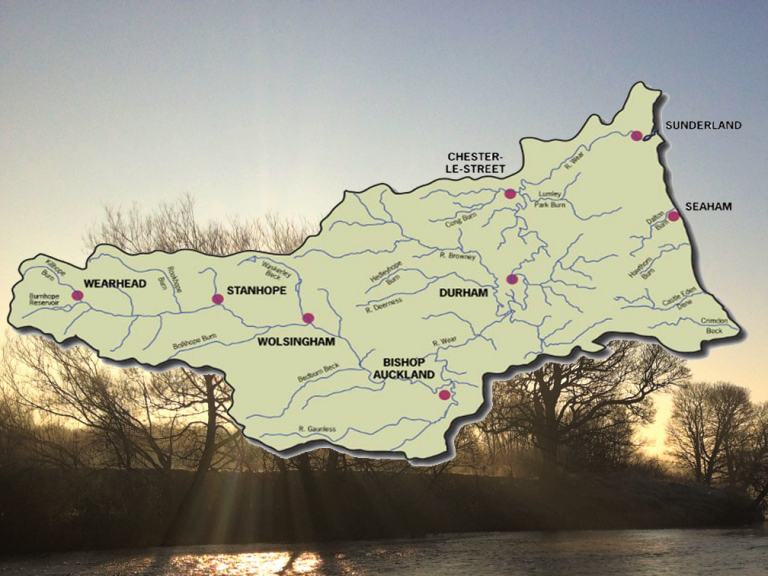
Rising in the North Pennines several streams drain from the hills between Killhope Law and Burnhope Seat to form the headwaters of the River Wear. The Wear begins where the Burnhope and Killhope burns merge at Wearhead. The high energy, rocky upland river flows eastwards through Weardale, gradually widening and deepening as it is joined by tributary rivers and streams, meandering its way through the more fertile flatter lowlands in the East of the county. The river is tidal from Chester le Street to Wearmouth, Sunderland, where it discharges to North Sea coastal waters. The Wear catchment has an area of 1080 square kilometers or 417 square miles. The main river is 97km or 60 miles long from Wearhead to Wearmouth. A series of deep wooded valleys or coastal denes arise independently from the Wear and discharge to the sea.
The Wear catchment is bounded by the catchments of the Tyne to the north, Eden in the West and Tees to the south, with the North Sea forming the eastern boundary.
4. Action Plan
4.1 Managing the Action Plan
The action plan drives forward the practical delivery of the principles contained within this management plan. Partners can nominate projects for inclusion in the action plan where overlapping opportunities have been identified, aligning the interests of and providing benefits to multiple partners.
The WCPG will decide if a nominated project is accepted on to the action plan.
The nominating partner will usually be established as a project lead, taking responsibility for the establishment and management of a project-specific subgroup, as required, comprising WCPG members and additional local actors as appropriate.
There may be a need for a project-specific Memorandum of understanding, depending upon the type and complexity of the project, the numbers and the expectation of participating partners.
The project lead will co-ordinate funding availability, including any match, the distribution of funds to participating partners and agreed delegation of tasks.
The project lead will also be responsible for the co-ordination of communication and engagement activities. As well as, for data collection and monitoring, but will delegate individual tasks to participating partners.
The project lead will further be responsible for reporting progress against the registered action plan to the WCPG.
The action plan is updated, controlled by version number, as projects are completed and registered. The current action plan is available here.